
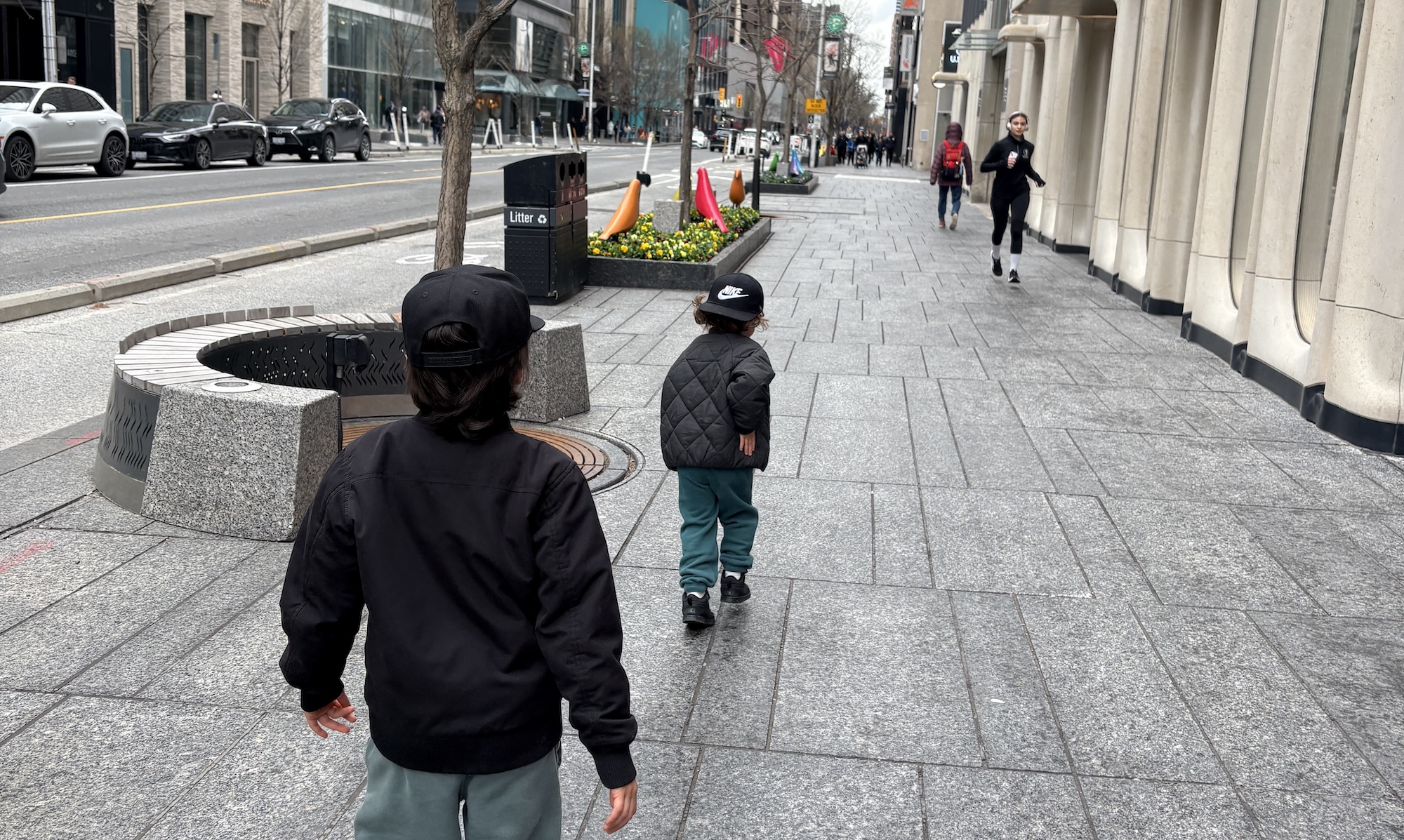
The detached house with a yard is the most oversold idea in Canadian family life. Children need green space and freedom. The city delivers both.
Announce a baby in Toronto and you will hear the same advice within the week. Sell the condo. Buy the house. Get the yard. The kids need room to run.
Here is my answer. Your kids do not need a backyard. They do not need a detached house. They need green space they can walk to, a school they can walk to, and a neighbourhood they are free to roam. That is not a description of a suburb. It is a description of a city.
This week, Mike Moffatt asked in The Globe and Mail whether children need a detached home with a yard to thrive. Moffatt, founding director of the Missing Middle Initiative, does careful housing work, and his column is more nuanced than its headline. But it feeds the oldest story in North American real estate: the city is for singles, and the suburbs are for families.
The evidence says otherwise. The suburb promises space. The city delivers a childhood. Here is the case.
01The detached house is a status symbol, not a parenting strategy
Start with what the column gets right, because it quietly undercuts the whole backyard dream.
Wealth does most of the work. Children raised in detached houses do tend to do better at school and later in life. But those families also tend to be wealthier, more often two-parent households, and more consistently employed. Moffatt acknowledges that once you account for those factors, most of the detached-house advantage disappears.
A detached house is not required. His actual standard is what he calls the kitchen-window test: can a parent see and hear a child playing outside from the kitchen? He argues townhomes, multiplexes and European-style courtyard apartments can all pass it.
Location already matters to families. In the poll he cites, more than half of respondents said being far from work or school would rule a home out for a family. That is a vote for neighbourhood, not for lot size.
So the real disagreement is narrower than the headline suggests. Moffatt argues the green space that matters most is the space attached to the home. I argue the space that matters most is the neighbourhood around it. The research, read in full, sides with the neighbourhood.
02The backyard study does not say what you have been told
The backyard case leans on a 2017 University of Glasgow study that followed 2,909 urban Scottish children from age four to six (Richardson et al., Environmental Research). The column says it found little evidence that nearby neighbourhood green space helped young children. The paper itself is more balanced.
- Neighbourhood green space did help. More natural space within 500 metres of home was linked to better social outcomes, and parks mattered for boys.
- The garden effect covers ages four to six. That is precisely the age when parents want a fenced, visible space.
- The authors explain it through supervision. They suggest parents simply feel safer letting a very young child play unsupervised in a private garden than in a park. That is a design problem, and courtyards, ground-floor family units and overlooked play areas can solve it.
- The authors hedge. They conclude a private garden may be most beneficial. It is an observational study, not proof.
What happens as children get older is the more revealing part. A later Glasgow study tracked Scottish 10 and 11 year olds by GPS (Olsen et al., 2022). Children from better-off areas got more time in nature, and most of it happened away from home. The advantaged children were not sitting in their gardens. They were roaming.
Brandon Donnelly made the cultural point well in his response to the column. Scotland is a place where houses with gardens are the norm. Across continental Europe, most families live in multi-unit buildings. Are those children, he asks, less developed?
03"Towers are bad for kids" is research about public housing, not your condo
The column also draws on a 2007 review of nearly 100 studies on high-rise living. This appears to be Robert Gifford's well-known review in Architectural Science Review (Gifford, 2007). It is the strongest evidence the backyard side has, and it deserves a fair hearing. Gifford found children in towers often played outside less, and he concluded high-rises are not optimal for children.
But read the fine print. Gifford himself says most of these conclusions depend on income, neighbourhood quality, parenting and whether families chose their housing. As urban economist Jason Barr points out, much of the underlying research studied public housing towers in declining American cities between the 1960s and 1980s.
That is not a story about building type. It is a story about place. A struggling tower on an isolated site and a well-run condo steps from a subway, a school and three parks are not the same environment. The problem was never the elevator. It was the neighbourhood.
04Kids need green. They do not need to own it.
Step outside the backyard framing and the strongest research measures something different: how much green surrounds a child's daily life.
Barcelona: the schoolyard beat the home. Researchers followed about 2,600 children aged seven to ten across 36 schools for a year (Dadvand et al., PNAS, 2015). Children at greener schools showed faster gains in memory and attention. Greenness around the home showed no significant link. Part of the benefit came from trees filtering traffic pollution.
Denmark: nearly a million children. Aarhus University researchers used satellite data to measure the green around the childhood homes of almost one million Danes (Engemann et al., PNAS, 2019). Those who grew up with the least green nearby faced up to a 55% higher risk of later psychiatric disorders, even after adjusting for urbanization and income. The measure was greenery within roughly a city block of home. Street trees, parks and courtyards count. A deed does not.
The reviews agree. Systematic reviews link green space to better mental health and cognitive development in children (Vanaken and Danckaerts, 2018). A 2023 review of 28 studies on school green space recommends renaturalizing schoolyards (IJERPH, 2023). None concludes that private green space beats public or school green space.
An honest caveat: most of this research shows associations rather than proven cause. But that cuts both ways. If correlational evidence is strong enough to argue for backyards, it is strong enough to argue for green streets, green schools and parks within a short walk.
A backyard serves a four year old. A city serves a fourteen year old.
05The backyard is a fence. The city is a world.
A backyard is a place a child can be. A neighbourhood is a world a child can move through. Researchers call this independent mobility: the freedom to walk to school, visit a friend or reach a park without an adult. It is one of the most important and overlooked parts of growing up.
Where children roam freely. A Policy Studies Institute survey of more than 18,000 children across 16 countries ranked Finland first (PSI, 2015). Most Finnish eight year olds could cross main roads and travel home from school alone. The top countries shared national policies supporting walking and cycling, and lower local speed limits. Freedom came from how places were built.
Japan shows density helps. In a national survey of 6,000 mothers, 82% of elementary children walked to school daily, more often in larger cities. A 2025 follow-up found children's independence was higher in more urbanized areas (Hino et al., Journal of Transport & Health). Density and transit, not lot size, created the freedom.
The suburban bubble, measured
Car-dependent places carry real, measurable costs for children, and they grow as children get older.
- More miles for teen drivers. Sprawl is linked to more daily driving by teenagers, whose fatal crash risk per mile is several times higher than adults' (Trowbridge and McDonald, 2008).
- More traffic deaths. Across U.S. counties, sprawl is tied to higher traffic and pedestrian fatality rates (Ewing et al., American Journal of Public Health).
- Less daily movement. Teens in walkable downtown Vancouver got more physical activity on the way to school than teens in car-dependent Surrey, even when taking transit (Frazer et al., 2015). Canada's kids already score a C minus on active transportation (ParticipACTION).
- A narrower world. When Australian children drew their neighbourhoods, those who walked to school showed real familiarity with their surroundings. Those driven drew isolated scenes centred on the car and the road (ACER for VicHealth).
That is the bubble. A suburban child can have a beautiful backyard and still experience the world through a car window. Every friend, every activity, every outing depends on a parent with keys. A city child walks to the corner store, takes the subway to a friend's place, and learns to read traffic, maps, strangers and moods. That is not a risk to development. It is development.
06Paris raises its kids in apartments. Nobody is worried.
If backyards were essential, Paris would be a developmental disaster. It is not.
Nearly every Parisian family lives in an apartment (ADIL de Paris). And Paris has surprisingly little park area per person, by some measures less than Midtown Toronto. What it has instead is distribution. The City maintains 536 parks, gardens and squares, plus thousands of smaller green corners (Ville de Paris). Walk any arrondissement and you find courtyards, parkettes and squares where adults sit, read and talk while children play a few steps away. It is shared, beautiful, and part of daily routine.
Paris is now pushing further, starting with schools, exactly where the Barcelona research says it matters most.
- Oasis schoolyards. Since 2018, the City has replaced asphalt with trees, gardens and natural play in 203 schoolyards, with 360 more planned by 2030 (Mairie du 10e).
- Open on Saturdays. As part of the 15-minute city, dozens of schoolyards and crèches open to families on Saturdays (Ville de Paris).
- School streets. Nearly 300 streets around schools have been closed to cars or traffic-calmed so children arrive safely and breathe cleaner air (Ville de Paris; Respire).
This is what a green space strategy looks like when a city takes children seriously. It does not ask every family to buy a lawn. It builds a shared garden a short walk from every door.
07Where the backyard camp has a point
A fair argument names its weak spots. Here are four, and how a city answers each.
- Toddlers are harder to supervise in a tower. True. The answer is design: ground-floor family units, courtyards and play areas overlooked by windows. That is exactly what Moffatt's push for European-style courtyard buildings aims for, and I support it.
- Family-sized condos are scarce. Also true. CMHC's deputy chief economist has called three-bedroom units rare and expensive. The answer is policy, and Toronto already has a tool: its Growing Up guidelines call for a quarter of units in new buildings to be two and three bedrooms, with real minimum sizes (City of Toronto).
- Apartments can feel crowded. Even in Paris, many families with children live in tight quarters (INSEE). Space matters. It is a reason to build better family homes in the city, not to abandon it.
- Midtown is short on parkland. Midtown has about 9.9 square metres of park per person, 65% below the Toronto average (City of Toronto). That is a call to build parks as we grow, including the City's proposal to deck over the Yonge subway trench with new green space (CBC).
None of these is an argument for the suburbs. Each is an argument for building our city better for families.
08Toronto families are already voting with their strollers
Toronto families are already choosing the city vertically. Over the past 20 years, the number of couples with children living in mid and high-rise buildings grew by more than 7,000, while couples with children in houses and low-rises fell by more than 10,000 (City of Toronto, 2024). Over the same period, the city's population of children under 15 fell by 11%. Families are leaving because of price and a shortage of family-sized homes, not because the evidence says children fare worse in the city.
In Midtown, the raw material is already here. Along the Yonge corridor, families can walk to Eglinton Park, Oriole Park, Sherwood Park's ravine, June Rowlands Park and Alexander Muir Memorial Gardens, with the Kay Gardner Beltline Trail running through the neighbourhood. Schools, libraries, shops and the subway are all reachable on foot. A ten year old here can walk to school, to the park and to a friend's place without anyone starting a car.
A better checklist for families
When you choose where to raise children, swap "Does it have a backyard?" for these questions.
- Is there a park within a five-minute walk? Proximity drives how often children actually use green space.
- How green is the school? The research suggests the schoolyard matters more than the home.
- Can a ten year old walk to school safely? Look at traffic speeds, crossings and sidewalks.
- What can a child reach alone? A library, a corner store, a friend's place, a transit stop.
- Does the building work for families? Real bedrooms, storage, shared amenity space and neighbours with kids.
- How much of family life depends on a car? Every drive is a trip your child cannot make alone.
09Raise them in the city
To be fair to the backyard, it is not nothing. A fenced yard is convenient with a toddler and lovely for a summer dinner. If a family can have one in a neighbourhood that also offers parks, walkable schools and real independence, that is a fine life.
But convenience is not development, and a lawn is not a childhood.
The research does not say children need to own green space. It says they need to be surrounded by it: on the walk to school, in the schoolyard, at the park around the corner. It says children thrive when they can move through their world on their own. And some of the countries that do best by their children raise them mostly in apartments, on bikes and in shared public space.
Donnelly ends his post with advice for city builders: start with the green space strategy, then choose the building type. I would offer the same advice to families. Start with the neighbourhood. Then choose the home.
So stop asking whether the house has a yard. Ask whether the neighbourhood has a childhood in it. For a lot of families, the honest answer is not at the end of a cul-de-sac. It is right here, in the city.
Raising a family in Midtown, or thinking about it? I am happy to walk you through the buildings, blocks and family-sized floor plans that actually work, from Roxborough to Lawrence Park.
Alexander YolevskiYolevski Real Estate · Midtown Toronto Condominium Specialists
Sources
- Moffatt, M. Do children need to grow up in a detached home with a yard to thrive? The Globe and Mail, October 2026.
- Donnelly, B. Do children need to grow up in a detached home with a backyard? October 12, 2026.
- Richardson, E. et al. The role of public and private natural space in children's development in Scotland. Environmental Research, 2017.
- Olsen, J. et al. Children's exposure to natural space and private gardens, measured by GPS. Landscape and Urban Planning, 2022.
- Gifford, R. The consequences of living in high-rise buildings. Architectural Science Review, 2007. See also Building the Skyline.
- Dadvand, P. et al. Green spaces and cognitive development in primary schoolchildren. PNAS, 2015.
- Engemann, K. et al. Residential green space in childhood and psychiatric disorders. PNAS, 2019.
- Vanaken, G. and Danckaerts, M. Green space exposure and children's mental health: a systematic review. IJERPH, 2018.
- School green and blue space exposure: a review of 28 studies. IJERPH, 2023.
- Policy Studies Institute. Children's independent mobility: an international comparison. 2015.
- Hino, K. et al. Children's independent mobility in Japan. Journal of Transport & Health, 2025.
- Trowbridge, M. and McDonald, N. Urban sprawl and miles driven daily by teenagers. American Journal of Preventive Medicine, 2008.
- Ewing, R. et al. Urban sprawl as a risk factor in traffic fatalities. American Journal of Public Health, 2003.
- Frazer, A. et al. School-travel physical activity in urban and suburban Metro Vancouver. Preventive Medicine Reports, 2015.
- ParticipACTION Children and Youth Report Card.
- ACER for VicHealth. Kids who walk are on track to better health.
- ADIL de Paris. Les chiffres clés du logement à Paris. INSEE housing data.
- Ville de Paris. Parks, gardens and squares; Cours Oasis; Saturday openings; Rues aux écoles.
- City of Toronto. Housing Occupancy Trends 2001 to 2021; Growing Up Guidelines; Midtown Parks and Public Realm Plan.
- CBC News. New green space over the Midtown subway; Families in Toronto high-rises.
Have questions?
Want to know more about Your Kids Don't Need a Backyard. They Need a City.? Send me a message and I'll get back to you within 24 hours.